
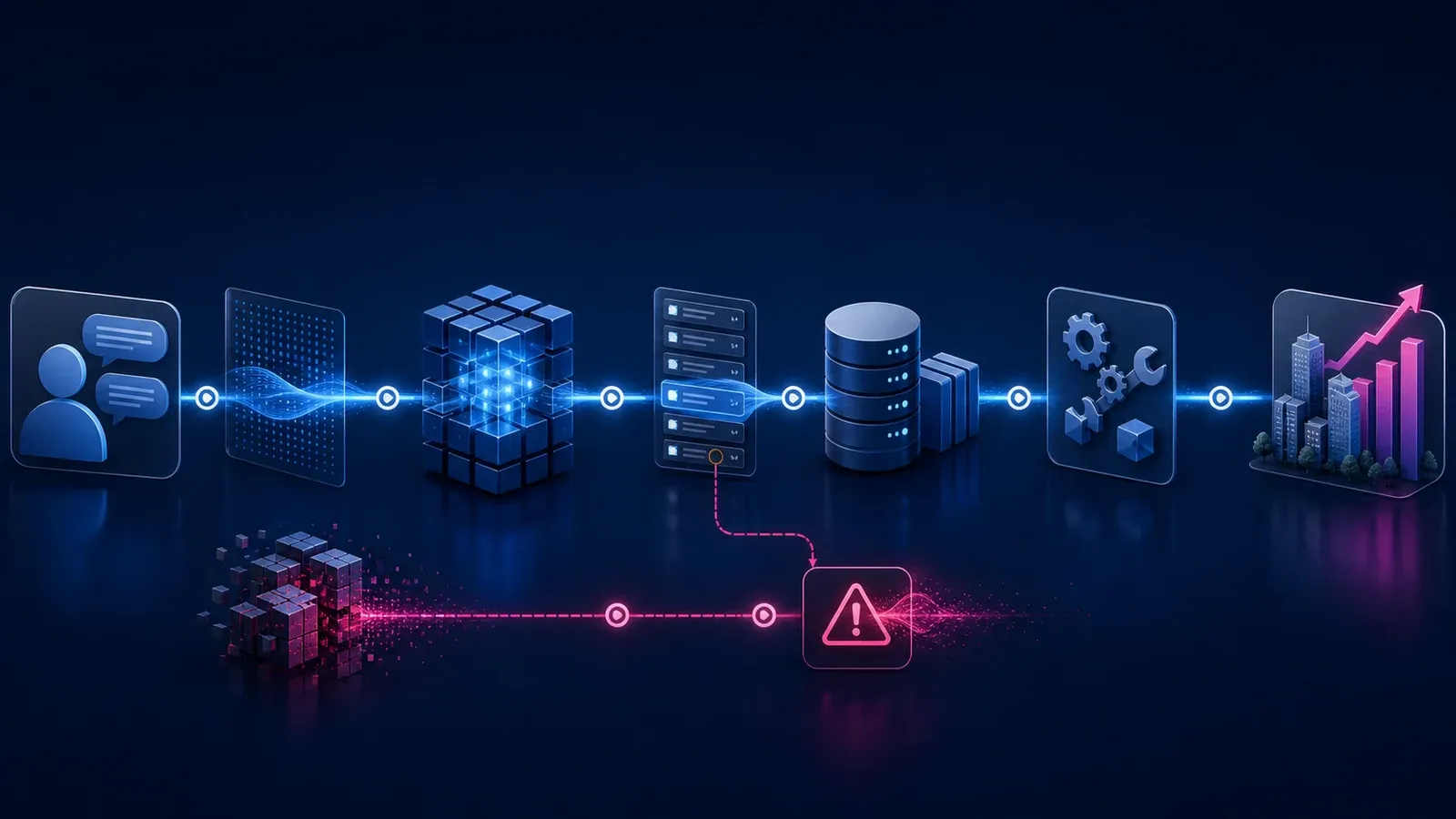
Traditional observability answers whether a service is available, fast and error-free. AI systems can return a technically successful response that is unsupported, unsafe or based on the wrong document. Teams need to observe both software behaviour and output quality.
AI observability connects each user outcome to the model, prompt, retrieval, tool calls, policy decisions, latency and cost that produced it—while minimising sensitive data collection.
The goal is explanation and improvement, not recording every conversation indefinitely.
Start with the business outcome
Define success at the workflow level: a case correctly triaged, an answer grounded in policy or a reconciliation completed. Track failure and escalation.
Technical traces should connect to that result. Token counts and model latency are diagnostics, not the reason the system exists.
Assign an owner who can act when outcome quality changes.
Create a trace identity
Give every task a correlation identifier across gateway, retrieval, model and tool services. Record model and prompt version, knowledge-index version, tool version and relevant policy decision.
For agents, record the sequence of tool selection, validated arguments, results and stop condition. Preserve approval events for consequential actions.
Use structured state rather than reconstructing everything from free-text logs.
Observe retrieval separately
Record source identifiers, ranking and filters without copying entire confidential documents into logs. Measure whether expected evidence was retrieved and whether restricted evidence was excluded.
Monitor stale sources, empty results and shifts in query patterns. Retrieval drift can reduce quality even when the model and prompt remain unchanged.
Give knowledge owners reports on repeated unanswered questions.
Capture quality signals
Use evaluation on sampled, privacy-reviewed outputs. Combine deterministic checks, calibrated model graders and human review. Track acceptance, correction, grounded claims and severe failure.
Segment by workflow, user and risk. An average can hide a failing high-value path.
Promote confirmed production failures into a regression set.
Monitor latency and cost by outcome
Break down retrieval, model, tool and queue time. Track retries and agent loops. Calculate cost per successful outcome, including human review.
Set budgets and anomaly alerts. A prompt change that doubles context size can create material cost without triggering an error.
Use service-level objectives suited to the workflow; an interactive assistant and overnight analysis have different needs.
Minimise and protect telemetry
Classify prompts, outputs and tool results. Redact secrets and personal data where possible. Restrict access, encrypt storage and set retention based on purpose.
Do not log hidden chain-of-thought. Record concise reasons, tool decisions and external evidence the system is designed to expose.
Review vendor telemetry and data use. Observability should not create a second uncontrolled data lake.
Build incident-ready controls
Create dashboards for denied actions, unusual retrieval, quality decline, provider errors and spend. Make it possible to disable a model version, tool or workflow independently.
Versioning and traceability should support reproduction. Include AI telemetry in incident response and post-incident review.
The NIST AI Risk Management Framework links measurement to ongoing management. Agentra and ValueCoders bring the AI product and engineering perspectives needed to operate that loop.
The minimum useful trace
Record task and user scope, component versions, permitted sources, tool actions, approval, latency, cost and final outcome. Add deeper detail only when it supports a decision.
AI observability makes probabilistic systems more operable by preserving the evidence around their behaviour. Trace enough to explain and improve; collect no more sensitive information than the job requires.
Establish service-level indicators
For a grounded assistant, indicators might include successful answer rate, citation validity, unsafe disclosure, human correction, p95 response time and cost per accepted answer. Set objectives by workflow and risk rather than one global target.
Create an error budget for quality as well as availability. If severe failures or corrections exceed the threshold, pause expansion and invest in data, retrieval or evaluation.
Review technical and business indicators together. A faster model may increase unsupported answers; a higher-quality model may create unacceptable queue time. Observability supports the trade-off rather than deciding it automatically.
Questions during a quality incident
Which user and workflow segments changed? Did the source data or retrieval index change? Which model, prompt or tool version is involved? Is the failure visible in existing evaluation? Can the affected path be disabled without stopping everything?
A well-designed trace answers these questions quickly. If incident response requires manually joining unrelated logs and asking several vendors for history, observability needs to become part of the architecture rather than remain a dashboard project.




Add to the conversation.
Be the first reader to add a useful perspective.