
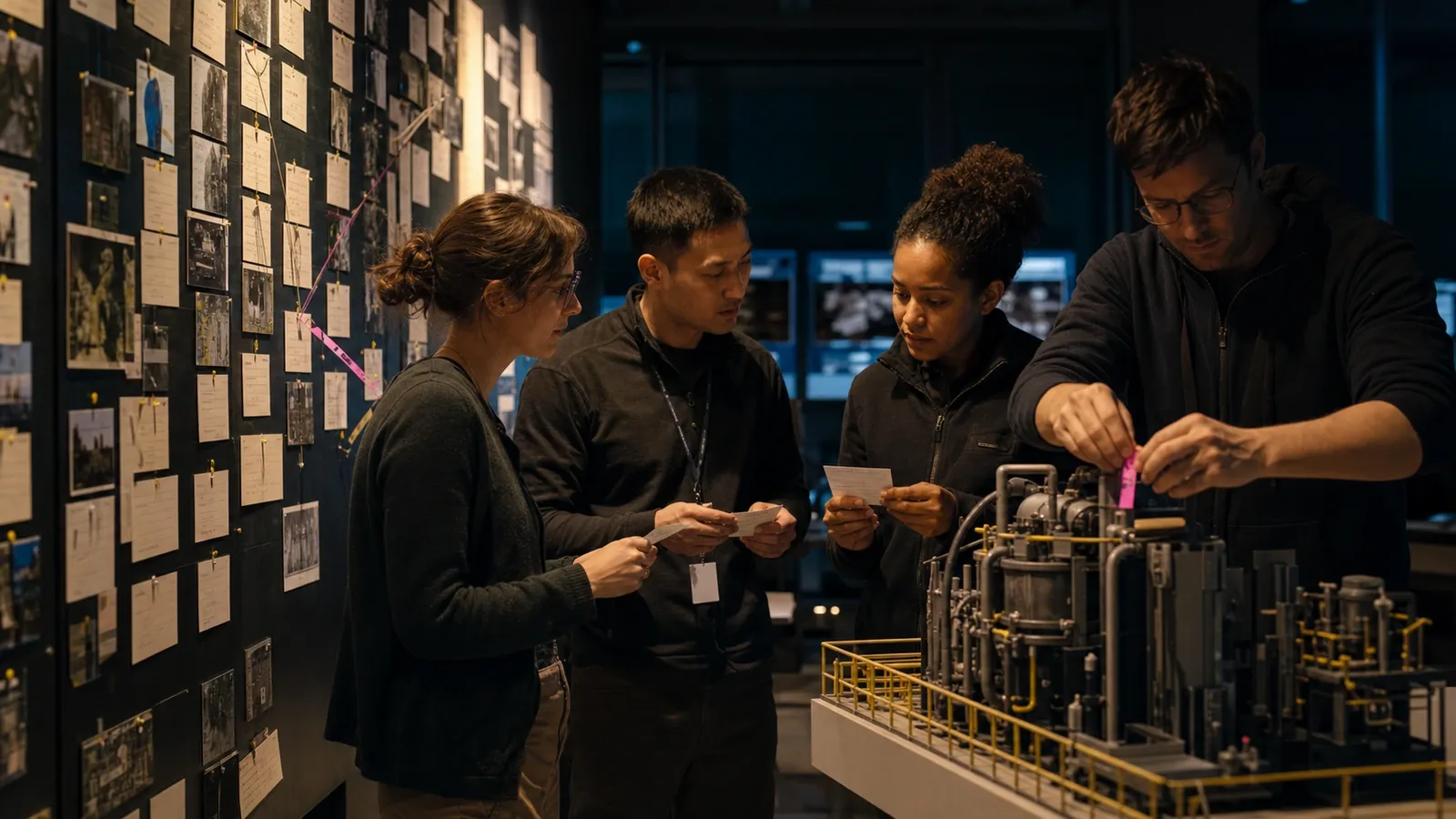
A production incident reveals how technology, process and decisions interact under pressure. If the review ends with “someone made a mistake,” the organisation wastes that information and makes future reporting less honest.
A useful incident review reconstructs what happened, explains the conditions that made the outcome possible and assigns improvements to the system—without removing individual accountability for deliberate or reckless conduct.
Blameless does not mean consequence-free. It means the review seeks causes that can be changed rather than stopping at the person closest to the failure.
Stabilise and communicate first
During the incident, establish an incident lead, technical responders and communication owner. Protect a clear channel for decisions. Record a timeline as events occur.
Prioritise customer and safety impact. Use prepared status templates and state what is known, unknown and happening next. Avoid speculative causes.
Preserve relevant logs and evidence subject to privacy and retention controls. Do not ask responders to write the final analysis while service remains unstable.
Reconstruct the timeline
Combine monitoring, deployment, support and communication records. Use a shared clock and include detection, diagnosis, mitigation, recovery and verification.
Interview participants while memory is fresh. Ask what information they had at the time, not what appears obvious afterwards. The review should explain why decisions made sense in context.
Mark gaps in observability and ownership. Uncertainty is a finding.
Identify contributing conditions
Go beyond a single root cause. Incidents often involve a code defect, permissive access, missing test, ambiguous alert, unsafe default, incomplete runbook and workload pressure together.
Ask which barriers should have prevented or limited impact and why they did not. Consider technical, organisational and supplier conditions.
Avoid “be more careful” as an action. Care is not an enforceable control.
Design proportionate improvements
Actions can eliminate the failure, reduce probability, improve detection or limit impact. Prefer systemic controls: validation, automated tests, safer deployment, permission boundaries, redundancy, alert improvement and rehearsed rollback.
Assign one owner and due date. Prioritise by risk; an incident can generate many ideas that compete with normal delivery. Track actions until verified, not merely marked complete.
Update runbooks and evaluation sets. For AI incidents, preserve model, prompt, retrieval and tool versions and add the failure scenario to regression testing.
Share learning safely
Publish an internal review accessible to affected teams. Remove sensitive customer or security detail where necessary. Share a customer-facing account when transparency is appropriate, focusing on impact, restoration and prevention.
Review patterns across incidents quarterly. Repeated alert, access or change-management issues signal a system-level investment need.
The Vinove operating standard asks whether technology works where it counts. Incident learning is part of holding that standard after release. ValueCoders represents the engineering capability behind systems that must recover as well as perform.
Protect the culture
Leaders should thank people who surface risk early and avoid public speculation about fault. Separate learning review from disciplinary or legal processes when deliberate conduct requires investigation.
Give responders recovery time. Chronic heroics are evidence of an under-designed operating system, not a sustainable culture.
The review template
Include summary and impact, detection, timeline, contributing conditions, what worked, what made response harder, actions with owners, and lessons relevant to other systems.
An incident becomes engineering memory only when the next team can act differently because the review exists. Honest reconstruction, systemic action and visible follow-through turn failure from a recurring surprise into improved resilience.
Keep actions connected to evidence
An action such as “add monitoring” is too broad. State the missed condition, proposed signal, threshold, owner and how the alert will be tested. “Document the process” should name the decision the runbook supports and the person who will rehearse it.
Classify actions as prevent, detect, mitigate or learn. A single incident does not justify every possible control, so prioritise by risk and expected effectiveness. Close low-value actions deliberately rather than leaving them overdue forever.
At the next quarterly review, ask whether completed actions changed another incident or near miss. This verifies that the organisation learned, not simply that tickets moved. Strong incident programmes build a feedback loop between real failure, engineering standards and investment decisions.
Questions before closing the review
Can another team understand the incident without attending the meeting? Does every action correspond to a contributing condition? Has the highest-risk improvement been tested? Were customer, security and privacy consequences considered? Who confirms that the learning changed the system?
Closing the document is not the final step. Close the loop only when important actions are verified and the pattern has been shared with teams that operate similar technology.




Add to the conversation.
Be the first reader to add a useful perspective.